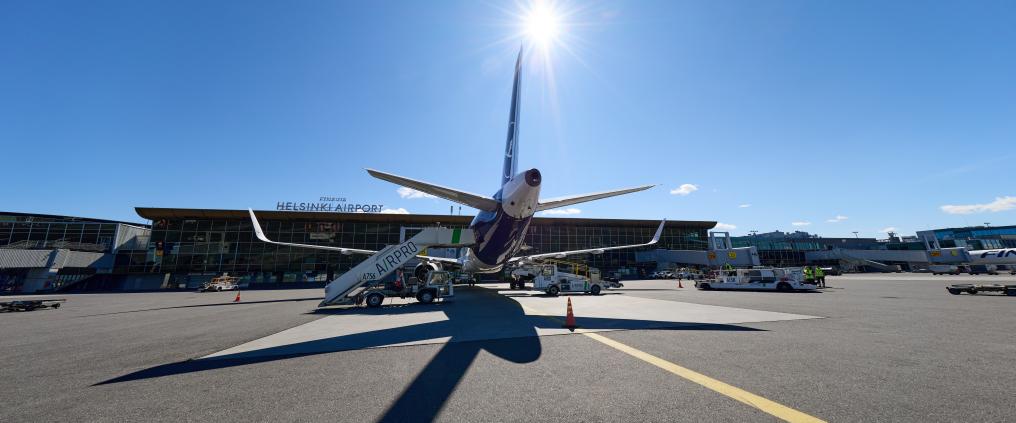
In 2026, several of the world’s largest airlines have been welcomed to Helsinki Airport. China Southern Airlines started operating between Beijing and Helsinki in spring 2026, and Qatar Airways reopened its Doha-Helsinki route in the summer. Airline Emirates will start flights between Dubai and Helsinki in October 2026.
The creation of new flight connections is a process that has many phases, and it is primarily influenced by the airlines’ strategy and business assessments. In this series of articles, we will explain how new flight connections are created, how Finavia cooperates with airlines and what factors influence the decisions of airlines.
What are airport charges and what do they consist of?
Airlines pay an airport charge for the use of the airport. Airport charges are used to finance the development and maintenance of the airports' infrastructure, security and passenger services. Finavia’s airport charges have the same content and amount at all twenty airports and all airlines operating to Finland.
"An airline will pay airport charges to the airport company in order to be able to operate to the airport of its choice. The charges cover, for example, the maintenance of runways and terminals, security control and other airport services," says Petri Vuori, Finavia’s Senior Vice President, Route Development.
Finavia’s airport charges consists of landing, security control, passenger and assistance service fees. The landing fee is calculated according to the maximum weight of the aircraft, and the other fees are calculated according to the number of passengers on the flight. In addition, Finavia charges air traffic monitoring charges determined by local air traffic control and the Finnish Transport and Communications Agency Traficom.
In Finland, airport charges are laid down in the law based on the EU’s Airport Charges Directive. The legality of airport charges is monitored by the Finnish Transport and Communications Agency Traficom, while Fintraffic is responsible for the pricing of Finland's air navigation services.
Finnish airport charges are affordable when compared internationally
Finland competes globally for flight connections, and airlines make decisions on new routes based on their own route strategy.
"Airlines assess new routes primarily from the point of view of demand and business profitability. The decisions are influenced, for example, by the passenger potential, the fleet in use and the total costs of the route, of which airport charge are only one part," says Vuori.
Airport charges generally account for approximately 5–15 per cent of the total costs of the flight route. In addition to the airport company, the airline also pays several service providers who prepare the aircraft for the next flight. In addition, country-specific taxation affects airline charges.
Finavia’s airport charges are public and uniform for all airlines operating to Finland. Helsinki Airport’s airport charges are very reasonable when compared to the public charges at other European airports (RDC, airportcharges.com, 2026). At the moment, Finavia’s airport charges are in the cheapest quarter compared to Helsinki Airport’s European competitor airports.
Development of airport charges in Finland
Finavia last updated its airport charges in January 2026, when the charges increased slightly. The increase was necessary to cover the general increase in costs and the deficit of airport operations. Air traffic and passenger volumes in Finland have not returned to the pre-COVID-19 level, and the costs of airport maintenance have increased significantly due to factors such as the economic situation in Finland and the increase in energy and material prices.
“Finavia’s goal is to offer airlines a competitive operating environment while ensuring that the safety, operational reliability and service level of airports can be maintained in the long term,” says Vuori.